For more than half a century, Clearwater has worked to protect the Hudson River through grassroots organizing in waterfront/Hudson Valley communities. Over the years Clearwater has been instrumental in advocating for the closure and now for the safe decommissioning of the Indian Point Nuclear Power Plant, for a comprehensive cleanup of General Electric’s legacy polychlorinated biphenyls (PCBs) pollution, and countless other campaigns that protect the Hudson River and the well-being of the residents on its shores.
Clearwater remains committed to our mission to protect the Hudson River, and to our efforts to raise public awareness of the issues threatening the river. We believe an educated and engaged citizenry is a powerful force for change.
Request a speaker from Clearwater
Stand up for the Hudson River – Ways to take action:
Check back soon for new action alerts!
Clearwater’s Advocacy Priorities
PCBs
Between 1947-1977 General Electric discharged over one million pounds of toxic polychlorinated biphenyls (PCBs) into the Hudson River, creating one of the largest Superfund Sites in the United States. PCBs take decades to break down and have accumulated in the sediment, water, and wildlife posing risks to ecological and human health. A review of the Superfund cleanup is due every 5-years, including a report on how successful the cleanup remedy has been, known as a Protectiveness Determination. Clearwater will be carefully watching this process along with our partners Friends of a Clean Hudson, and will keep the public engaged and informed. Learn more about General Electric’s polychlorinated biphenyls (PCBs) contamination of the Hudson River.
Indian Point
After decades of grassroots advocacy and legal action by Clearwater and our partners, the last reactor at the Indian Point Nuclear Power Plant closed in April 2021. In collaboration with the Indian Point Convergence, Clearwater successfully championed the creation of a Decommissioning Oversight Board to oversee the decommissioning of the facility. Clearwater continues to be an active advocate and ally to the community striving to ensure the safest decommissioning possible. Learn more about our work on Indian Point.
Newburgh PFAS Drinking Source Water Contamination
The City of Newburgh’s drinking water source, Washington Lake was contaminated with Per- and poly-fluoroalkyl substances (PFAS) from firefighting foam runoff from Stewart Air National Guard Base. PFAS has been linked to increased cholesterol, increased risk of high blood pressure in pregnant women, decreased infant birth rates, and heightened risks of kidney or testicular cancer. Since May 2, 2016, the City of Newburgh has received drinking water from alternative sources, though PFAS-contaminated Washington Lake remains the permanent drinking water source for the City of Newburgh. Clearwater is a member of the Restoration Advisory Board and joins the community in advocating for timely remediation of Washington Lake. Learn more about Newburgh’s drinking source water contamination.
New York State Canal System + Invasive Species
The Erie Canal and Mohawk River have become a thoroughfare for invasive species to enter the Hudson River from the Great Lakes. A recent example is the round goby – native to Eurasia, gobies are voracious feeders, reproduce rapidly, and compete with native species for food, habitat, and spawning areas. The spread of non-native species into the Hudson through the canal is not a new occurrence, and unless swift action is taken, it will not be the last. On the horizon are species including invasive carp, which are populous in the Mississippi watershed and on the doorstep of the Great Lakes Watershed. Once there, they could follow the goby’s route to the Hudson.
Swimmable Hudson
Clearwater was an instrumental force in the initial passage of the Clean Water Act in 1972, which established goals of zero water pollution discharges by 1985 and for all U.S. waters to be swimmable and fishable by 1983. Nearly 40 years later, the Hudson River ecosystem and swimmability are improving, but discharges continue, the river is not always safe for swimming and significant fish consumption advisories remain in place. Clearwater will continue to support efforts to improve water quality and quicken progress toward CWA goals, through advocacy, education, and amplifying the desire of communities to fish and swim in the Hudson River safely.
For more information about Clearwater’s Environmental Action work, contact Jen Benson, Environmental Action Director at jen@clearwater.org.
Help us continue our efforts to protect the Hudson River. Support Clearwater’s Environmental Action efforts.
Recent blog posts

ACTION ALERT: Tell NYCEDC PortSide NewYork Needs a Home
July 24, 2025 Update: The EDC vote on the Economic Development Council is postponed indefinitely. Thank you for your advocacy! Over the years Clearwater has been priced out of all the [...]
Environmental Groups Condemn EPA’s Final Review of the Hudson Superfund Site
FOR IMMEDIATE RELEASE: JANUARY 17, 2025 Environmental Groups Condemn EPA's Final Review of the Hudson Superfund Site The Upper Hudson River PCB cleanup is not protecting Hudson River communities and the environment HUDSON VALLEY, N.Y.—Environmental [...]
New York State Bans CO2 Fracking
We are thrilled to share Governor Kathy Hochul signed A8866/S8357 on Saturday night, banning the use of CO2 for fracking! The bills expanded the existing NYS fracking ban to prevent CO2 fracking in addition to [...]

Environmental Groups Challenge Findings in EPA’s Hudson River Superfund Site Review
November 8, 2024 FOR IMMEDIATE RELEASE: Environmental Groups Challenge Findings in EPA’s Hudson River Superfund Site Review EPA Must Acknowledge Cleanup Does Not Protect Human Health and the Environment Hudson River Valley – Yesterday the [...]
ACTION ALERT: Hudson River PCB Contamination
For 70 years, 200 miles of the Hudson River has been contaminated by toxic PCBs released by General Electric making our river one of the largest Superfund Sites in the United States. As required [...]
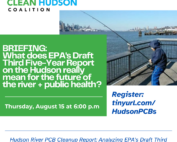
BRIEFING: What does EPA’s Draft Third Five-Year Report on the Hudson really mean for the future of the river and public health?
WHEN: Thursday, August 15 at 6:00 p.m. WHERE: Virtual Via Zoom Scenic Hudson, Riverkeeper, and Hudson River Sloop Clearwater invite you to join the Friends of a Clean Hudson coalition for a virtual update [...]
Hudson River Coalition Firmly Rejects Findings in EPA’s Draft Third Five-Year Report for the Hudson River PCBs Superfund Cleanup
FOR IMMEDIATE RELEASE July 10, 2024 Hudson River Coalition Firmly Rejects Findings in EPA’s Draft Third Five-Year Report for the Hudson River PCBs Superfund Cleanup Groups call on the public and elected representatives to speak [...]
With the Hudson River PCBs Superfund Site Five-Year Review Approaching, Congressional Leaders Urge EPA to Rule that Additional Cleanup is Needed
FOR IMMEDIATE RELEASE Apr 16, 2024 With the Hudson River PCBs Superfund Site Five-Year Review Approaching, Congressional Leaders Urge EPA to Rule that Additional Cleanup is Needed General Electric discharged more than a million [...]